Mithuna Couple Flanked by Yakshis (Indic Fertility Symbols)
1st-3rd CE, Murti, Chakwal, Pakistan
Artefact Details
Yakshas (male nature spirits) and yakish is (their female counterparts) trace their origins to the early protohistoric and, later, the Vedic traditions of South Asia, where they emerge in Sanskrit literature as potent guardian spirits of nature, wealth, and fertility. The Atharva Veda and subsequent Puranic texts depict them inhabiting forests, mountains, and watercourses, capable of both benevolence and caprice. Cultic practices throughout South Asia -ranging from folk shrines to ritual offerings-attest to their deep~rooted significance for agrarian communities seeking protection and prosperity. Their gradual assimilation into Brahmanical, Buddhist, and Jain cosmologies demonstrates their adaptability and enduring appeal across diverse religious landscapes.
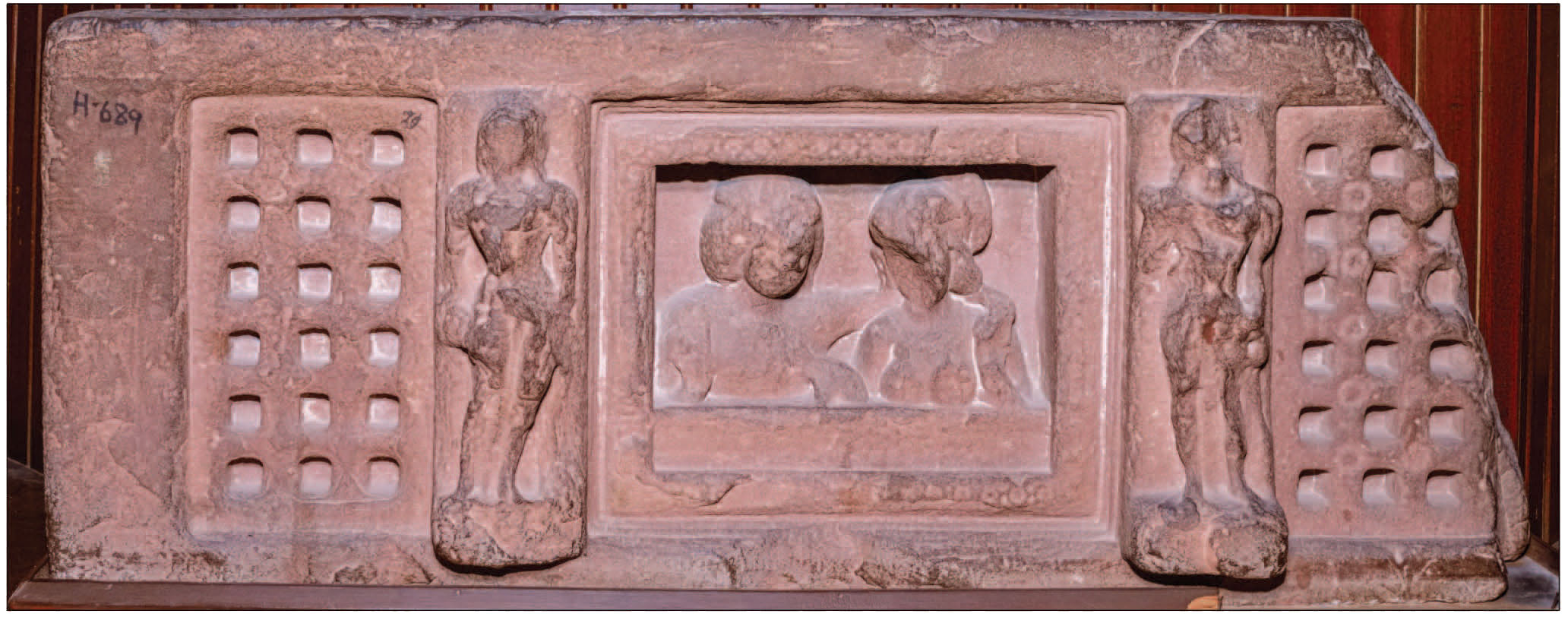
Yakshas and yakshis occupy a crucial mediatory role in Jain devotional practice, bridging the austere transcendence of the Tirthankaras with the material aspirations of lay followers. Unlike Tirthankaras ( who embody asceticism and spiritual liberation), yakshas and yakshis are sensuous, fertile figures capable of bestowing wealth, health, and protection. They are never worshipped as supreme deities but venerated as powerful nature~spirits whose material boons complement the Tirthankaras' spiritual guidance.
Visually, yakshis are often depicted in close association with trees, snakes, and other natural motifs, and are rendered as curvaceous, partially clothed or nude figures adorned with heavy ornamentation. Their iconography emphasises abundance: broad hips and full breasts signal fertility, while relaxed postures suggest ease and approachability. In many Jain contexts, yaksha-yakshi pairings extend into the broader category of mithuna (male-female) unions, though Jain texts prefer the Sanskrit terms yugala ( couple) and yugalika (female counterpart) to underscore their auspicious, society~founding significance. Mithuna couples are often depicted holding hands, embracing, or gently touching each other.
In the context of Jainism, such imagery functions less as an expression of sensuality and more as a symbolic representation of harmony, fertility, and auspiciousness-bestowing blessings upon devotees and reflecting ideals of worldly balance.
A paradigmatic example is Ambika, the yakshi attendant of the twenty~second Tirthankara Neminatha, who is frequently shown with children or beneath a mango tree to reinforce her role as a fertility guardian. The prominence of yakshas and yaks his in sites like Murti reflects their importance for devotees ( especially those unable to undertake strict renunciation), enabling lay worship that honors both transcendental ideals and earthly rhythms of Jain practice. Their enduring presence in temple reliefs and portable sculptures testifies to the intimate entwining of Jain religiosity with nature's bounty.
Research by Aqsa Hasan
Write-up by Taymur Jibran Kashif