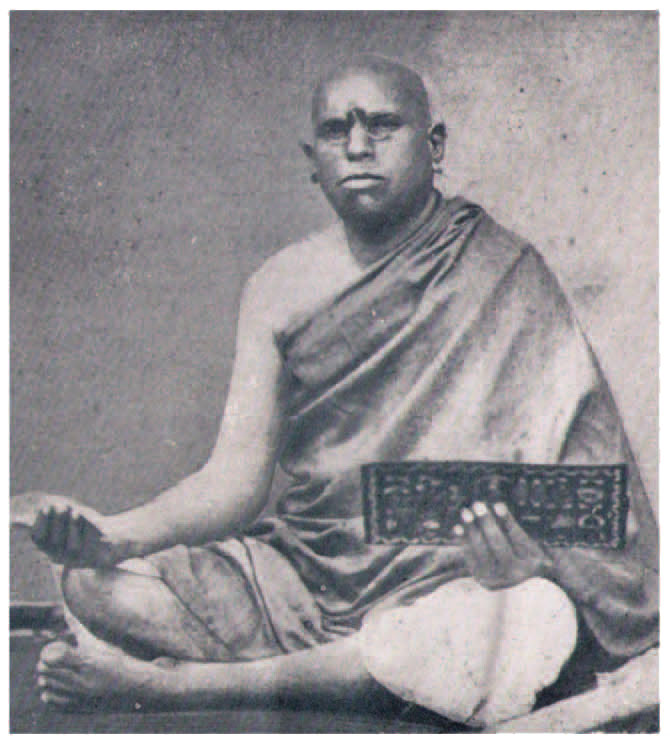
Jain Monk Shri Atmaram
1897CE, Shri Atmaram's Samadhi, Gujranwala, Pakistan
Artefact Details
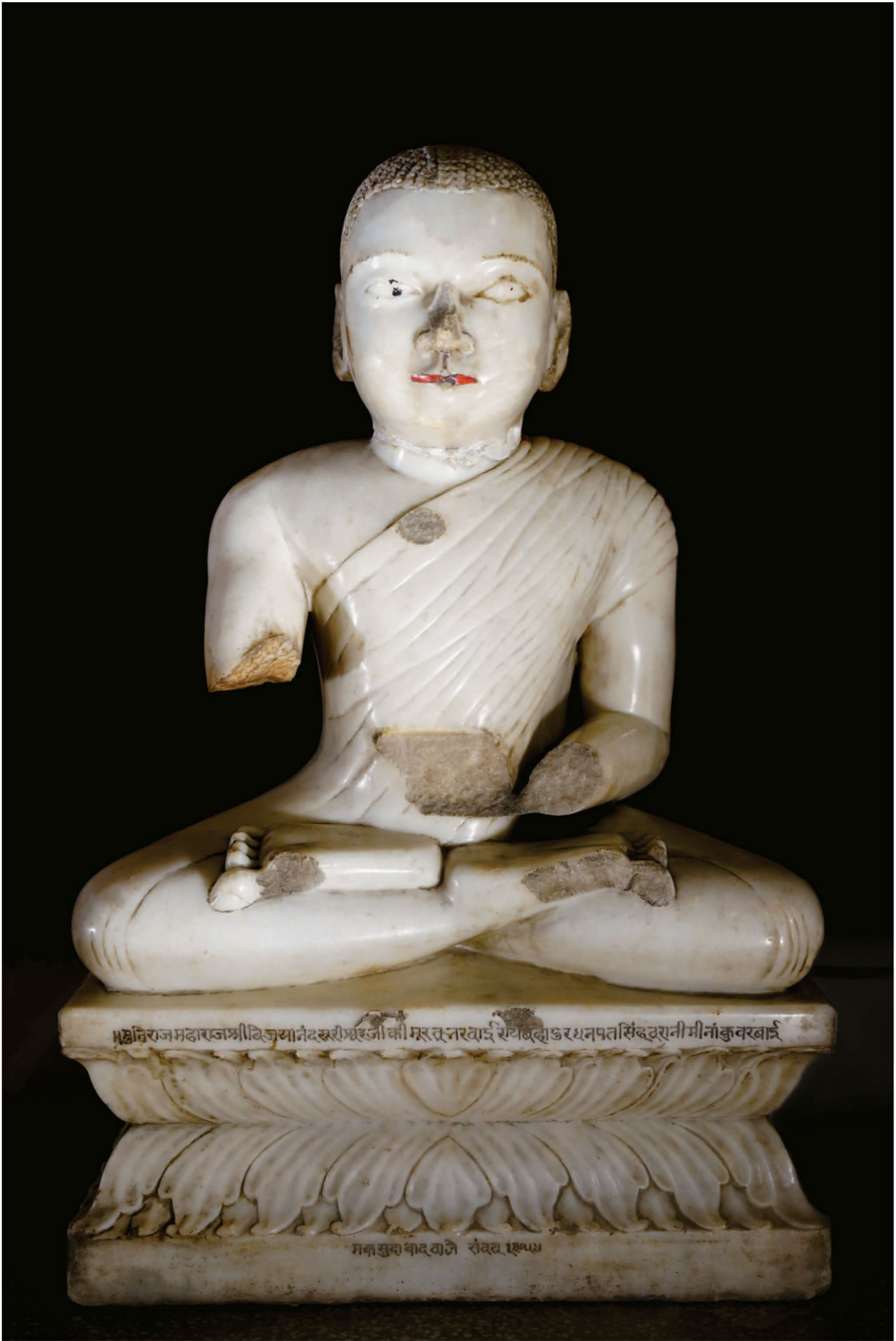
This sculpture depicts Shri Atmaram, also known as Acharya Vijay Anand Suri, seated on a lotus pedestal-an enduring Indic symbol of purity and spiritual awakening. Placed beside him is a chauri, or flywhisk, traditionally signifying servitude and the presence of a higher authority on whom the beholder must wave it. In this context, it reflects Shri Atmram's devotion and lifelong service to the Jinas. Although the sculpture is missing both arms, similar depictions of Jain monks and photographs of Shri Atmaram seated in a similar posture suggest that the sculpture likely held a manuscript in one hand and a muhapatti in the other. The muhapatti is a small piece of cotton cloth used to cover the mouth during ritual practices and recitation by monks and nuns to prevent harm to small organisms in the air. His simple monastic robe draped over one shoulder, paired with the absence of a shrivatsa on his chest, helps distinguish this figure from a Jina. Images of the Tirthankaras commissioned by the Shvetam~ bara ( white~clad) sect include cloth covering the lower body while images from the Digambara (sky~clad) sect depict nude figures. Moreover, a Sanskrit inscription at the base identifies the figure as Shri Atmaram and offers the names of the patrons as Rai Bahadur Dhanpat Singh, and Rani Minakuwar Bai of Makasudabad (Kanpur, India) in 1897 (VS 1954).
Born in 1837 in Lehra, Ferozepur, into a Hindu family, Atmaram took the Jain oath of renunciation at the age of sixteen. He was formally granted the tide of Acharya in Palitana in 1886, marking his leadership in the wider Jain community. A reformist and revivalist, he played a pivotal role in promoting education ( especially for women), revitalising Jainism in the Punjab, and contributing to its dissemination in the Western world. He was a celebrated preacher, scholar, and poet whose hymns are still recited in Jain temples. He passed away in 1896, en route from Narowal to Gujranwala, where he had intended to establish a Jain temple. After his death, his followers not only honored his wish and built the temple but also commissioned his samadhi (funerary monument) in Gujranwala. This sculpture, completed a year earlier in 1897, was installed in the samadhi in 1904, serving as both a spiritual icon and a tribute to his enduring legacy.