Chaubisi-A Jain Altarpiece
1486 CE, Findspot unknown
Artefact Details
This cast bronze altarpiece, known as a chaubisi (from chaubis, meaning twenty~four), presents the complete Jain pantheon of twenty~four Tirthankaras. While the central figure's identity is uncertain due to the loss of surface detail from prolonged ritual use, shoulder~length hair, characteristic ofR.ishabhdev, can be seen skimming theJina's shoulders. An animal shaped cognizance bearing a hump in the centre of his seat suggests it may be a bull, the lakshana of Rishabhdev the 1st Jina, depicting the start of the Tirthankara lineage. Rishabhdev also known as Adinatha sits under a triple parasol on a simhasana, a lion throne where addorsed lions are seated with the dharmachakra between them. Mahavira, the last Jina sits above him under a parasol with two Jinas standing on either side of his throne in kayotsarga position. Flanking him are another two seated Jinas, both shown with multi~ hooded cobra aureoles, Suparshvanatha, the 7th Jina, and Parshavnath, the 23rd in line. The rest of the Tirthankaras are shown either in the kayotsarga position or seated in dhyana-mudra.
Chaubisi—A Jain Altarpiece (English)
Chaubisi—A Jain Altarpiece (Urdu)
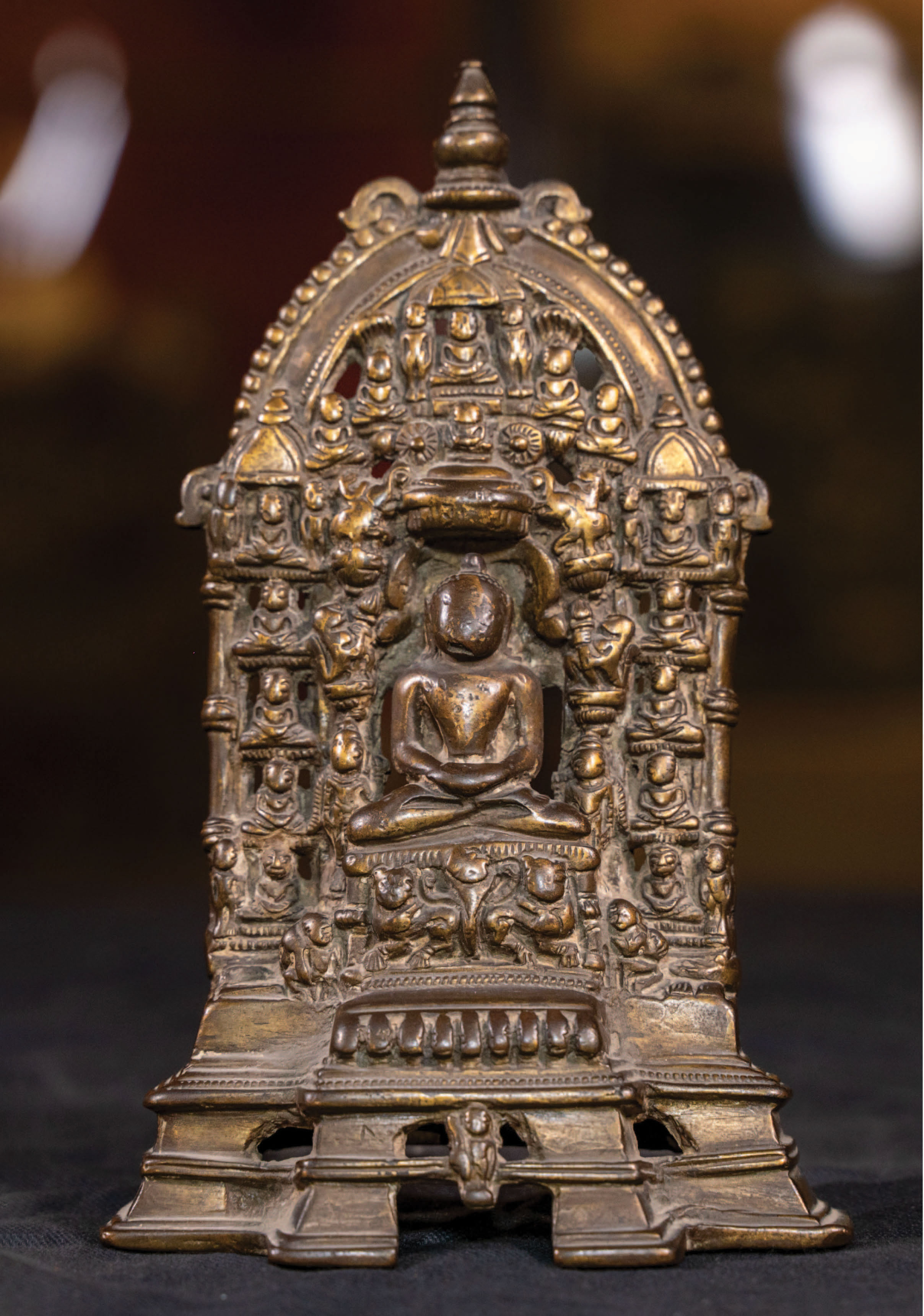
Two elephants standing on lotuses, with a drum beater in the middle, are lustrating Rishabhdev. On either side of the drumbeater are the sun and moon, representing timelessness of this assemblage and the blessings they impart to the donor and viewers. R.ishabhdev's simhasana is flanked by a yaksha holding a mace and yakshi holding a child, recalling imagery associated with deities like Ambika and Gomedah/Sar~ vanubhuti, emblems of fertility, abundance and compassion. Below this are nine projections that have lost their details. These symbolize the nine planets, a usual feature of such altarpieces.
Mostly manufactured in Gujarat, it was a usual practice for the Jain community to donate such altarpieces to their temples. A dedicatory inscription on the reverse of this chaubisi records its consecration: "In the Vikrama year 1543, on the 3rd day of the bright half of the month Vaisakha, by a devotee named Shri Lasagha'' corresponding to AprilMay 1486. This detail anchors the sculpture within a late medieval context, which explains the significant wear on its surface which likely resulted from centuries of devotional handling and the repeated applica~ tion of ritual substances such as sandalwood paste. Despite this weathering, several key iconographic features remain legible. This chaubisi serves not only as an object of worship but also continues to amaze visitors at the museum by its compact but rich religious symbolism.