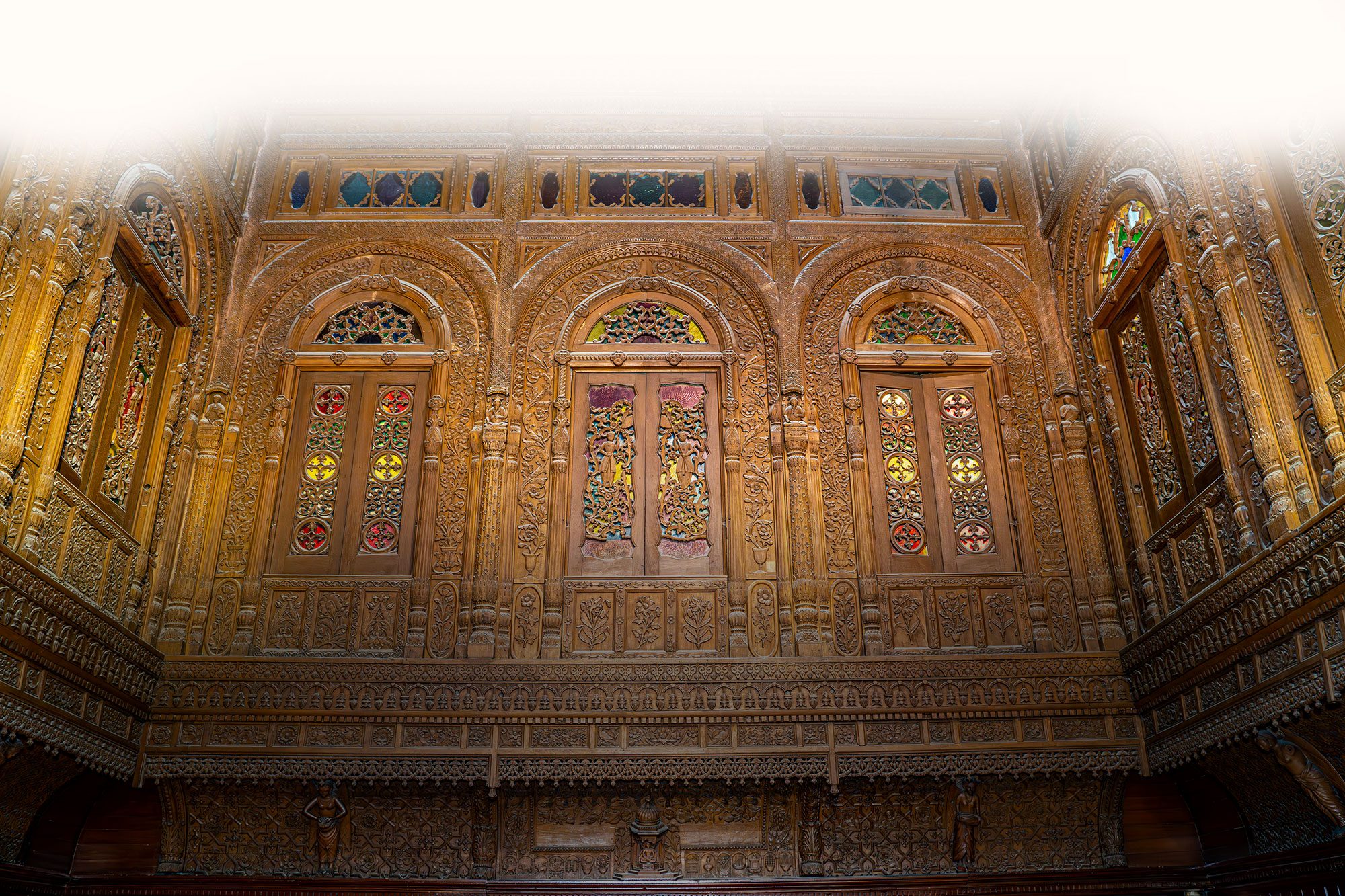
A Carved Balcony from the Gujranwala Jain Mandir
1940s CE, Jain Temple, Gujranwala, Pakistan
Artefact Details
This carved balcony was originally a part of the Jain Mandir in Gujran~ wala, a Shvetambara temple completed in 1941. Located in Bhabra Bazaar, the temple stands within the BhabrianJain Mohalla, situated behind the Sheranwala Bagh and its baradari. Today, this area is a hub of gold jewellery and metalware production, echoing the traditional occupations of the BhabraJain community that once resided here. The temple is dedicated to Parshvanatha, the 23rd Jain Tirthankara. It is also associated with Acharya Vijay Anand Suri (also known as Shri Atmaram), who had envisioned a central Jain temple in Gujranwala, but who passed away before this wish could materialise. His followers fulfilled his aspiration posthumously, dedicating the temple to his memory.
Carved Balcony from the Gujranwala Jain Mandir (English)
Carved Balcony from the Gujranwala Jain Mandir (Urdu)
This Jain temple was a three~storied structure with a community hall and served the Jains of Gujranwala until 1947, after which it fell into disuse. Sometime in the 1970s, this significant wooden balcony, along with numerous other artefacts, was salvaged and relocated to the Lahore Museum. During the 1992 retaliatory attacks after the Babri Masjid demolition, the temple suffered significant damage. Sub~ sequendy, the remaining structure was repurposed into commercial and residential units. Today, only a few parts of the building remain intact, including a sikhara.
Carved in teak wood, identifiable by its grain and hue, this balcony is a testament to the unbroken wood carving traditions of the Punjab, despite the disruptions brought to local crafts during the colonial period. In its present condition in the Museum, the balcony is displayed in a U~shaped configuration. However, in its original form, it likely adorned the facade of the mandir. The structure features a total of seven windows, set in semicircular arches carrying pieces of coloured glass of which three are in the central section and two each in the sides flanking it.
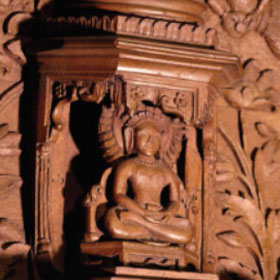
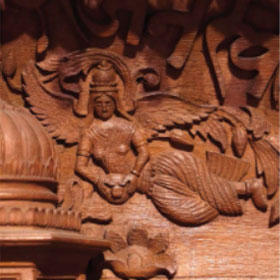
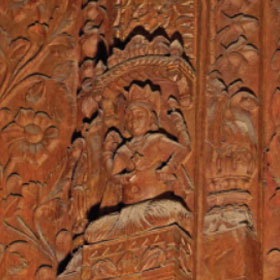
The decorative program of this structure is laid out in three tiers, with the lowest section resting above the main entrance and serving as the focal point. Here, a chhatri~like niche houses the figure of Parshvanatha, seated in meditation. The Jina is identified by a cobra~ hood behind his head and a serpent marking the top centre of his seat, his distinctive mark or lakshana. Above the chhatri, a Devanagari inscription reads, "Shri Parshva Prabhu Mandir Jain Shvetambara;' confirming the temple's dedication and sectarian lineage. Flanking the Jina are two crowned apsaras in low relief pouring water from vessels (echoing Gaja Lakshmi iconography), a typical lustration scene in Hindu traditions which symbolises royal authority and divine blessings. Apsaras are celestial nymphs, depicted as beautiful, ethereal dancers and musicians. Surrounding the Jina are fourteen auspicious emblems which are markers of good fortune. These symbols appeared to the mothers of Tirthankaras in dreams, foretelling the birth of an enlightened soul. The carved emblems include an elephant, a bull, a lion, the goddess Lakshmi, twin garlands, the sun, the moon, a banner, an overflowing pot, a lotus lake, a heap of jewels, a smokeless fire, a celestial chariot, and a celestial throne. This panel is framed within a grapevine motif with parrots and features additional symbols like the Jain endless knot-one of the eight auspicious Jain signs. As we look to the sides, we find six larger winged female figures almost carved in the round. These creatures known as vidyadharas are seen playing musical instruments (from left to right) a rabab (a rebeck), taal (cymbals), a drum, a dholak (a double~headed handheld drum), and a taus (a peacock~shaped stringed instrument). Unfortunately, one of the figures has lost both her arms and her musical instrument.
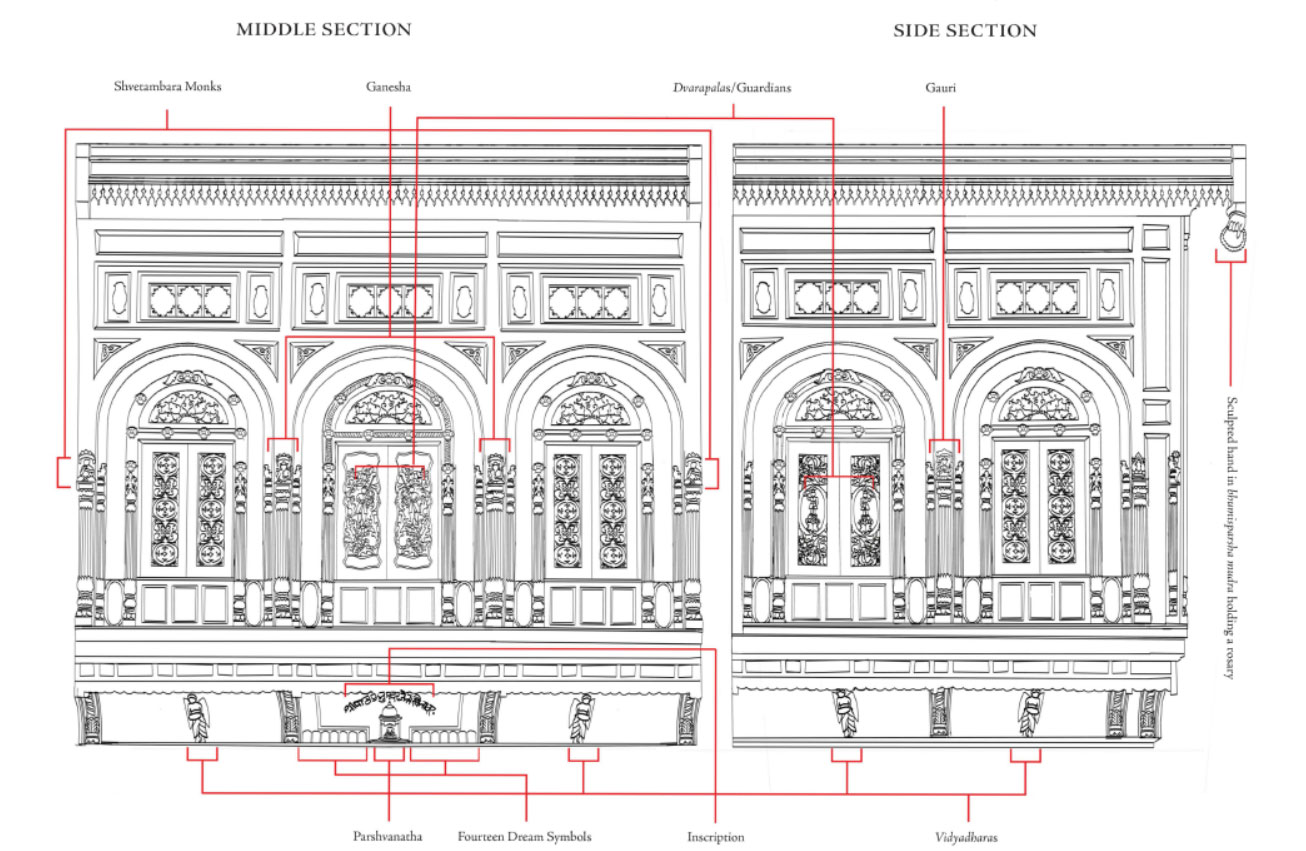
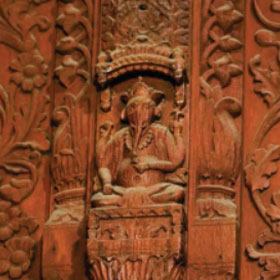
The windows are flanked by ornate compound pillars with niches bearing figures. The central section features Ganesha and Shvetam~ bara monks. Ganesha is regarded as the remover of obstacles, while the munis (monks) are identifiable by their pose, monastic garb, and the scriptures held in their hands. Similarly, the left and right flanks likely showcase Gauri, a guardian deity symbolising devotion, meditation, and selrawareness. Three out of the seven windows feature male figures known as dvarapalas (guardians) carrying different objects in their hands, shown standing in perpetual attendance. The pair on the central window bears fans or pennants, while the ones on the sides carry flywhisks, showcasing their servitude to the residents of this building. The remaining four windowpanes are decorated with geometric patterns reminiscent of European designs such as the Gothic quatrefoil and clover patterns amidst scrolling foliage. Each panel at the base of the windows features a singular flowering plant, with some shown in beautifully rendered pots. In the rest of the area surrounding the windows are realistic and stylised vegetal patterns featuring numerous flowers like roses, irises, grapevines, daffodils, lotuses, tulips, jasmine, carnations, chrysanthem~ urns, lilies, morning glory, hibiscus, and more, ranging from 5 to 8~ petalled blooms. These patterns are interspersed with a wide variety of birds such as cuckoos, nightingales, parrots, and hamsa (goose), creating an imagery of a verdant paradisiacal setting. Some panels feature stylised lotus designs, eight~pointed stars, and geometric patterns. Traditional temple motifs such as the chain and bell, tassels, and bands of inverted lotuses divide one section from the other.
This structure presents a vibrant example oflate colonial Jain architecture in the Punjab. It synthesises ShvetambaraJain icono~ graphy with late Mughal, Sikh, and colonial decorative vocabularies. The temple not only fulfilled the spiritual vision of Acharya Vijay Anand Suri but also embodied the identity, devotion, and artistry of a once~flourishingJain community in Gujranwala.